Microsoft’s New AI Content Standards: Proving Truth Online
Discover how Microsoft’s 2026 AI safety plan uses C2PA Content Credentials and digital watermarking to distinguish real media from AI-generated deepfakes.
AI
Ram Charan Singh
2/24/20265 min read
The digital world is currently facing an unprecedented crisis of confidence. As generative artificial intelligence becomes more sophisticated, the line between a genuine photograph and a synthetic fabrication has blurred to the point of invisibility. From viral deepfakes of world leaders to sophisticated misinformation campaigns designed to sway public opinion, the "seeing is believing" era of the internet is effectively over.
Recognizing this threat to digital stability, Microsoft has unveiled an ambitious new blueprint aimed at restoring trust in the online ecosystem. This initiative isn't just about catching "bad" AI; it’s about creating a verifiable "paper trail" for every piece of digital media we consume. By championing a new set of technical standards, Microsoft hopes to provide users with the tools to definitively answer one of the most pressing questions of our time: Is this real, or is it AI?
The Growing Crisis of Digital Deception
The urgency behind Microsoft's new plan is fueled by a staggering rise in AI-enabled deception. We are no longer just dealing with obvious "face-swaps" or clunky parodies. In 2026, AI tools can generate hyper-realistic video, perfectly cloned voices, and authoritative-sounding text in seconds.
For the average internet user, the stakes have never been higher. Misinformation can influence elections, crash financial markets, and destroy personal reputations before a correction can even be issued. Microsoft’s strategy acknowledges that traditional AI detection—the "cat-and-mouse" game of software trying to spot glitches in an image—is no longer a sufficient defense. Instead, the focus is shifting toward content provenance—a way to certify exactly where a file came from and how it was changed.
Understanding C2PA: The Core of the Strategy
At the heart of Microsoft's proposal is the adoption and scaling of the C2PA (Coalition for Content Provenance and Authenticity) standard. Think of C2PA as a digital "nutrition label" for media. Rather than listing ingredients and calories, these content credentials provide a cryptographic record of a file’s history.
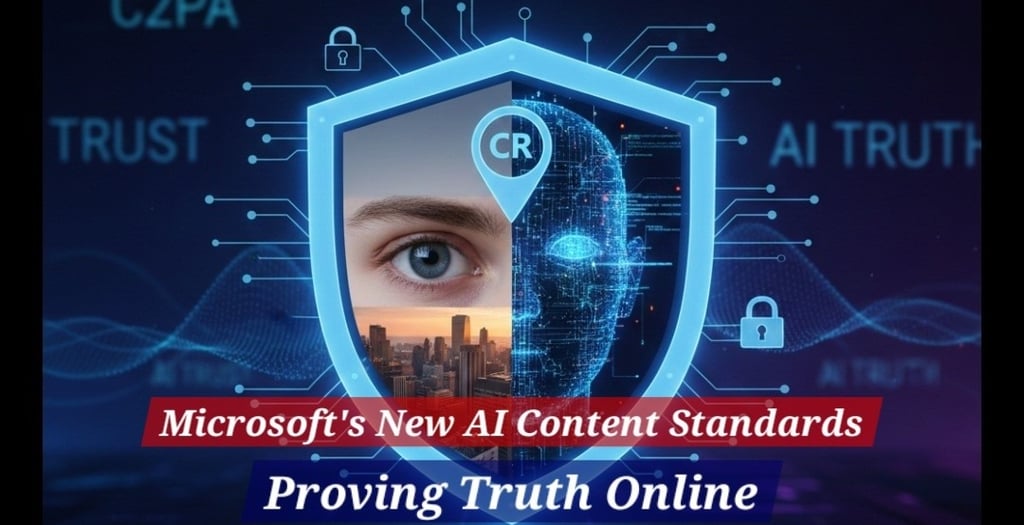
When a photo is taken with a C2PA-enabled camera, a digital signature is embedded into the file. If that photo is later edited in Photoshop or run through an AI upscaler, those actions are recorded as "assertions" within the file's metadata. By the time the image reaches your social media feed, you can click a small icon—often referred to as the "CR" (Content Credentials) pin—to see a verified timeline of the image's life cycle.
Key Components of Microsoft’s Plan:
1. Widespread Integration: Microsoft is embedding these credentials into its own massive ecosystem, including Bing, Microsoft Designer, and select Office applications.
2. Edge Browser Verification: The Microsoft Edge browser, used by over 300 million people, will act as a primary "validator," showing badges on images that have verified provenance.
3. Open Access for Creators: The plan emphasizes democratizing these tools, allowing independent journalists and small creators to sign their work just as easily as major news organizations.
The Duel-Layer Defense: Watermarking vs. Metadata
One of the most significant insights from Microsoft’s 2026 report is that no single technology is a "silver bullet." Metadata, while powerful, can often be stripped away when an image is screenshotted or shared on platforms that don’t support the C2PA standard.
To counter this, Microsoft is pushing for a hybrid approach that combines metadata with digital watermarking. Unlike visible logos, these digital watermarks are often invisible to the human eye but can be detected by software even if the image is cropped, compressed, or re-recorded. By linking these two technologies, Microsoft aims to create a "tamper-evident" seal that remains attached to the content regardless of how it is distributed across the web.
Addressing the "Text Authenticity" Challenge
While certifying images and videos is a massive step forward, the world of AI-generated text remains a "wild west." Microsoft’s plan acknowledges that text is significantly harder to verify than visual media. Because text is just a series of characters, there is currently no way to "embed" a permanent digital signature that survives a simple copy-paste.
To address this, Microsoft is experimenting with "source-link" transparency in Bing Chat and Copilot. By providing direct, verifiable links to the original documents used to generate a response, the company is attempting to move away from "black box" AI and toward a model of responsible AI that prioritizes traceability.
The "CSO Paradox": Challenges to Mainstream Adoption
Despite the technical brilliance of the plan, Microsoft’s strategy faces internal and external hurdles. Critics and industry analysts have pointed out a "commitment gap" within the tech giant itself. While Microsoft’s research and safety teams are pioneering these standards, the company’s Chief Security Officer has, at times, been hesitant to mandate these features across every single platform immediately.
The hesitation often stems from concerns over user privacy and platform friction. If every image requires a "certificate of authenticity," does that slow down the internet? Does it infringe on the anonymity of whistleblowers or activists in sensitive regions? Microsoft’s challenge in 2026 is to balance the need for digital literacy and transparency with the fundamental right to digital privacy.
Why Digital Literacy is the New Essential Skill
Technology alone cannot solve the problem of "fake news." Microsoft’s 2026 blueprint places a heavy emphasis on education. In a world where 90% of online data has been created in just the last few years, the ability to critically evaluate content has become a survival skill.
Microsoft’s vision for mainstream adoption involves making these verification tools so intuitive that checking an image's "credentials" becomes as natural as checking a verified blue checkmark on social media once was. By providing a "pin" or a badge, they hope to nudge users toward a more skeptical, informed way of consuming digital media.
Looking Ahead: The Future of Truth Online
As we move further into 2026, the battle for digital truth will only intensify. Microsoft’s plan represents a shift in philosophy: we are moving from a reactive stance (trying to catch fakes) to a proactive one (certifying what is real).
The success of this initiative depends on cooperation. For C2PA to work, it needs to be adopted not just by Microsoft, but by Adobe, Google, Meta, and the manufacturers of the smartphones we carry in our pockets. If the industry can align on these standards, we may finally see the dawn of a new era of internet transparency.
Summary and Key Takeaways
Microsoft’s new plan is a comprehensive effort to bring order to the chaos of the AI era. By leveraging content provenance, digital watermarking, and the C2PA standard, the company is building the infrastructure necessary to protect users from the harms of AI-enabled deception.
Key Value Takeaways:
1. Transparency is the Goal: The focus is on providing a verifiable history for digital files rather than just "detecting" AI.
2. Hybrid Technology: Combining metadata with invisible watermarks ensures that credentials "stick" to the content.
3. Ecosystem Power: Microsoft is using its massive reach via Edge and Bing to force these standards into the mainstream.
4. Human Element: Ultimately, the technology is only a tool; the final defense remains a user's own digital literacy and critical thinking.
The fight against misinformation is far from over, but with these new standards, we are finally getting a map to navigate the digital fog. By supporting responsible AI and demanding transparency from the platforms we use, we can begin to rebuild the trust that the AI revolution has so deeply shaken.
E-mail: contact@ramcharansingh.online
Phone: +91-72487-51410
Copyrights © 2026. Ram Charan Singh. All rights reserved.
Crafting the future through technology, creativity, and the power of a well-told story.
Our Social Media Links